The Manifesto project from week one seems such a long time ago. Time to tidy up the thoughts, processes and review.
“Learning without thought is labour lost; thought without learning is perilous.” – Confucius. 551–479 bc.
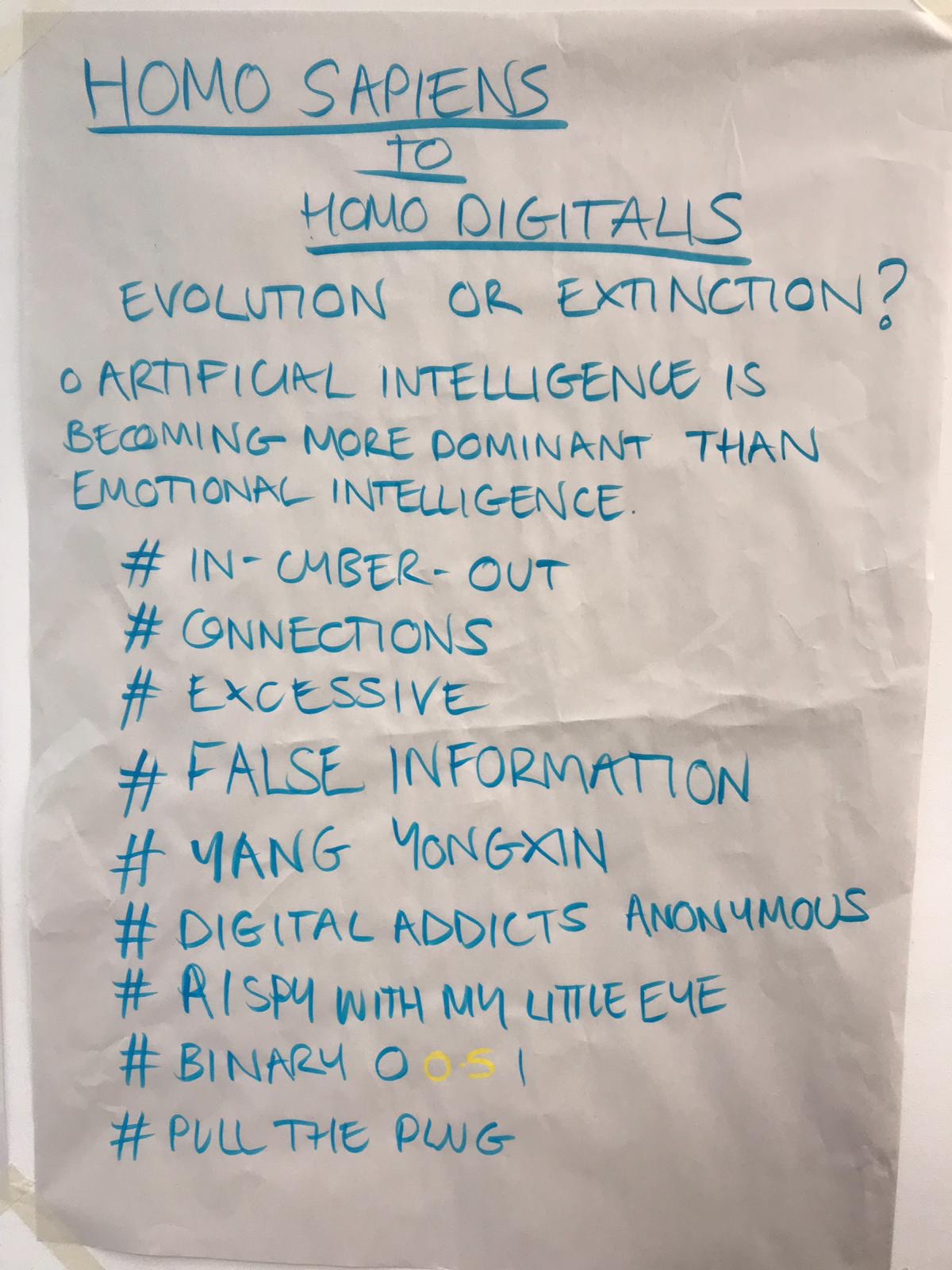
Our manifesto, ‘Homo Sapiens to Homo Digitalis’ is to examine group 8’s concerns bought about by our technological advancement and the introduction of the digital into our lives.
We agreed that technological advancement needs to be examined from a moral and spiritual perspective, as well as from a legislative and educational angle.
I like the idea that before and hopefully in our future man shall find guidance within spiritual teachings with practical solutions.
We strived to achieve a spiritual balance while dealing with the unknown, we embraced change and searched for harmony.
I would like to try and find solutions through making pictures that effectively addressed our concerns and suggest solutions, both spiritually and practically, but my clumsy appropriation of the yin yang symbol was wrong.
I would like to find a more appropriate way of expressing a search for balance through balancing out and juxtaposing my work but when the yin yang image worked so well on the laser cutter I felt it was right. I probably need to see how many other spiritual base ethos fit my enquiry and gather them together so it may correctly be seen as an inspirational thought, not a statement and go on looking for “my way.”
In 500 words, I shall be able to only be able to address one point of this manifesto.

The feelings of loneliness bought about by isolation occur with both cyber violations and with addiction.
Artists do and have made inquiries into this in past and suggest solutions.
Michael Ignatieff in his book The Needs Of Strangers uses Shakespeare’s King Lear, Saint Augustines’s Confessions, Hieronymus Bosch’s paintings to illustrate the problems while finding possible solutions though Hume, Rousseau, and Adam Smith.
https://www.goodreads.com/author/show/50189.Michael_Ignatieff
Scientists exploring addiction, eating disorders, depression and antisocial behaviour, which excludes people from mainstream society, are suggesting that treating the feelings of loneliness may well be a route to recovery and re-inclusion.
Johann Hari discusses this in his ted talk, Everything you think you know about addiction is wrong (Johann Hari | TEDGlobalLondon)

Artist Edward Hopper described as a lonely teenager, seems to have explored solitude in his paintings and by doing so connected with others and they connected with him.
Tim Marlow introduces Edward Hopper in sixty seconds saying he is just responding and engaging with the every day and the mundane.
A fascinating introduction to his 2016 show at Boston’s Museum of Fine Arts places him in context with his contemporaries and film noir.

Tap for the trailer.
Jeff Koons‘s “transponder” paintings, give us a reflection of ourselves and include us in the narrative of the work we are looking at.
“That’s where the art is. The object doesn’t have any art in it; it’s just a transponder that can stimulate. The art happens inside the viewer”

Koons discusses the thought process- tap link to read the article-
https://www.artsy.net/article/artsy-editorial-jeff-koons-five-ambitious-unrealized-projects
Maybe these pieces make the audience and the artist, in turn, felt less isolated.

Nighthawks, 1942 oil on canvas painting by Edward Hopper

Manal Massalha came to talk to the RCA Grad. Dip. and introduced us to her work.
She is a ethnographer and photographer.
Her photographic practice engages with the every day and the mundane, the human and the urban, the cultural and the social, the political and the economical.
She was the first to document Focus E15, the single mother’s housing campaign against eviction and in support of social housing in London, which became inspiring for other housing campaigns.
She must make her subjects feel less alone and has given them exposure on platforms where they may be heard.
She mentioned that she always asks before photographing and warn those who become her subjects that although she may highlight and document their situations it may not lead to a solution.

Computers have gone from the size of a small house to something you hold in your hand they are all around us and in some cases, in us.
They are not going away, so we need to address them.

In an article published by the Guardian this week, they have cited research that has shown it is the sleep deprivation that is causing the trouble amongst the population not the other use of our electric gadgets.
I think The guardian article may have a point and that the simplest solution to the questions that our manifesto raised is to “ Unplug” for a while, make a cup of tea, break bread with our “families” or get a good book out and reconnect with ourselves and with those around us.
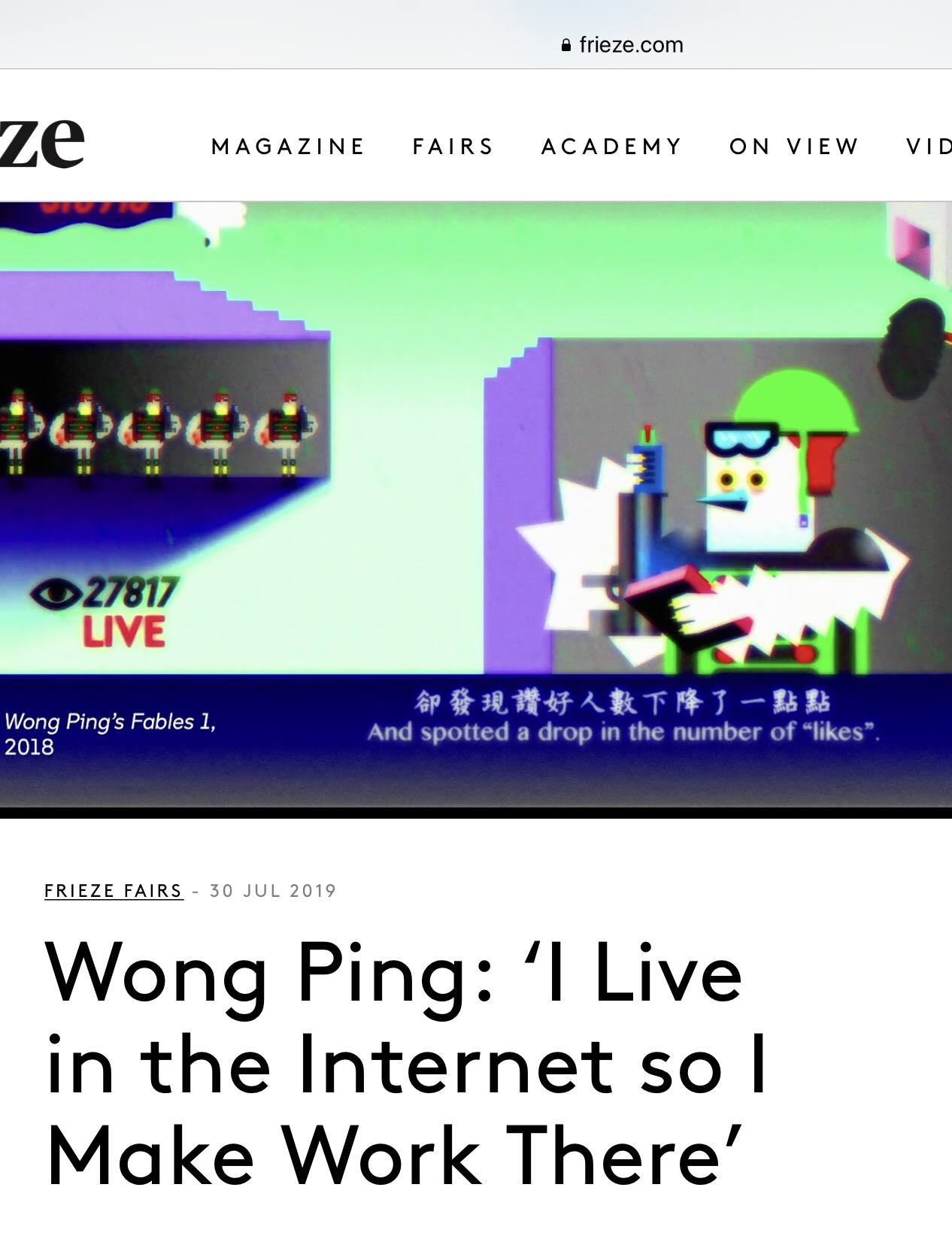
Wong Ping’s Artwork and life are very contemporary and every part of it touches technology. He talks about his work at the TV station, reading and he also shows his animation to his parents which he says he enjoys.
He seems to be successfully balancing his world.
I think this simple approach is not flippant but practical, is generally the advice of the moment from
CAMHS the mental health department within the UK health services. (NHS).
We all need to enjoy what is right in front of us and engage with curiosity enjoying the things we do.
Looking at and appreciating the everyday world around us, even if it is just what makes a lemon so lemon, we can discuss that if nothing else. I believe paintings can give us conversation pieces, common ground to connect. By being attractive they can draw us in, hook us and the art can happen inside us.


 Sarah Chalkie Cloonan
You must be logged in to post a comment.