We cannot assimilate knowledge without learning so my question is how do we learn.
methodology and pedagogy
Socrates – Pedagogy is an art (5th century BC).
The main difference between Pedagogy and Methodology is that the Pedagogy is a discipline that deals with the theory and practice of education and Methodology is a systematic, theoretical analysis of the methods applied to a field of study.
A pedagogical methodology is a set of procedures that a teacher can develop in order to help all students learn.
A methodology – is the complex result of instruction, personal experience and reflection.
- The five major approaches are Constructivist, Collaborative, Integrative, Reflective and Inquiry Based Learning ( 2C-2I-1R )
the acquisition of knowledge or skills through study, experience, or being taught.
It was God Cheiron, if we believe Greek mythology, who taught the first teacher, as that the centaur was known for his abilities to impart knowledge it seemed a sensible choice.
Cheiron himself had been instructed by Apollo and Artemis, and was renowned for his skill in hunting, medicine, music, gymnastics, and the art of prophecy.
https://www.theoi.com/Georgikos/KentaurosKheiron.html#:~:text=249.),and%20the%20art%20of%20prophecy.
Knowledge is among the many kinds of cognitive success that epistemology is interested in understanding.
Plato’s epistemology was an attempt to understand what it was to know, and how knowledge (unlike mere true opinion) is good for the knower.
https://plato.stanford.edu/entries/epistemology/
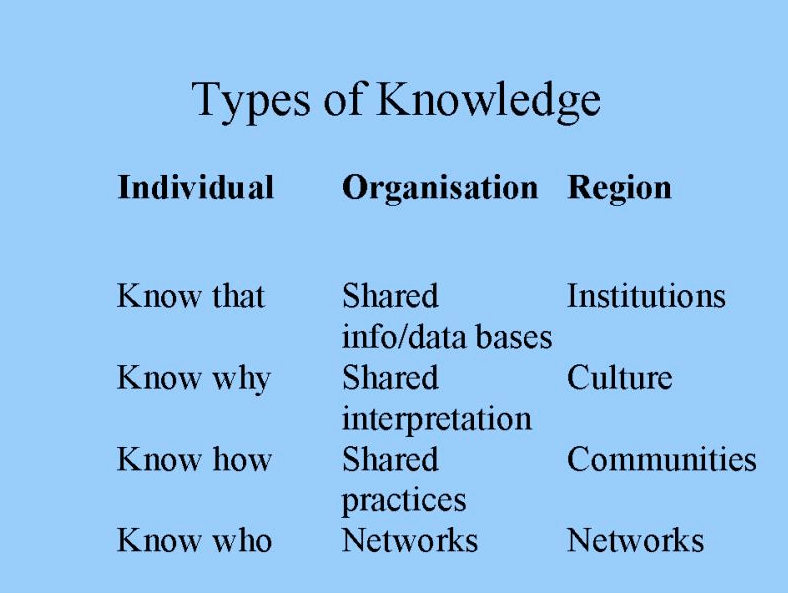
What are the 4 types of knowledge?
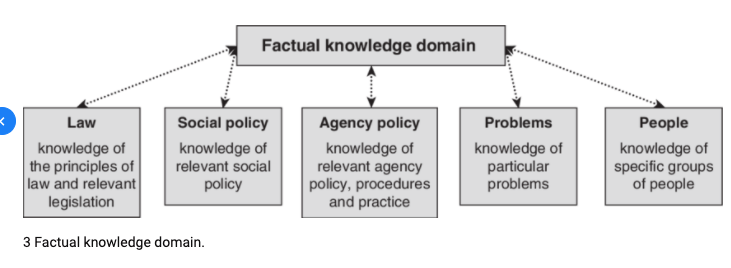
According to Krathwohl (2002), knowledge can be categorized into four types: (1) factual knowledge, (2) conceptual knowledge, (3) procedural knowledge, and (4) metacognitive knowledge.
https://sites.google.com/site/elearningsnippets/a-wiki-page/krathwohl-s-taxonomy
http://cehdclass.gmu.edu/ndabbagh/Resources/IDKB/krathstax.htm
Factual knowledge may be described as the basic information about a particular subject or discipline.
Conceptual Knowledge refers to the knowledge of, or understanding of concepts, principles, theories, models, classifications, etc. We learn conceptual knowledge through reading, viewing, listening, experiencing, or thoughtful, reflective mental activity. Also referred to as Declarative Knowledge.
Procedural Knowledge refers to the knowledge of how to perform a specific skill or task, and is considered knowledge related to methods, procedures, or operation of equipment. Procedural knowledge is also referred to as Implicit Knowledge, or know-how.
Metacognition is one’s ability to use prior knowledge to plan a strategy for approaching a learning task, take necessary steps to problem solve, reflect on and evaluate results, and modify one’s approach as needed. It helps learners choose the right cognitive tool for the task and plays a critical role in successful learning.
https://lincs.ed.gov/state-resources/federal-initiatives/teal/guide/metacognitive
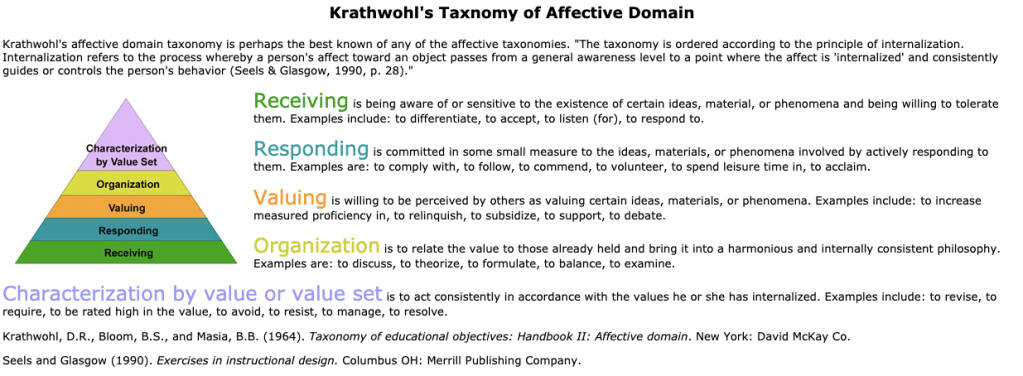
Education and learning in the work place leading to a more fufulled community and existance
Epistemology
First published Wed Dec 14, 2005; substantive revision Sat Apr 11, 2020
The term “epistemology” comes from the Greek words “episteme” and “logos”. “Episteme” can be translated as “knowledge” or “understanding” or “acquaintance”, while “logos” can be translated as “account” or “argument” or “reason”. Just as each of these different translations captures some facet of the meaning of these Greek terms, so too does each translation capture a different facet of epistemology itself. Although the term “epistemology” is no more than a couple of centuries old, the field of epistemology is at least as old as any in philosophy.[1] In different parts of its extensive history, different facets of epistemology have attracted attention. Plato’s epistemology was an attempt to understand what it was to know, and how knowledge (unlike mere true opinion) is good for the knower. Locke’s epistemology was an attempt to understand the operations of human understanding, Kant’s epistemology was an attempt to understand the conditions of the possibility of human understanding, and Russell’s epistemology was an attempt to understand how modern science could be justified by appeal to sensory experience. Much recent work in formal epistemology is an attempt to understand how our degrees of confidence are rationally constrained by our evidence, and much recent work in feminist epistemology is an attempt to understand the ways in which interests affect our evidence, and affect our rational constraints more generally. In all these cases, epistemology seeks to understand one or another kind of cognitive success (or, correspondingly, cognitive failure).
https://plato.stanford.edu/entries/epistemology/
Steup, Matthias and Ram Neta, “Epistemology”, The Stanford Encyclopedia of Philosophy (Fall 2020 Edition), Edward N. Zalta (ed.), URL = <https://plato.stanford.edu/archives/fall2020/entries/epistemology/>.
John Locke: (1632-1704)
John Locke was among the most famous philosophers and political theorists of the 17th century. He is often regarded as the founder of a school of thought known as British Empiricism, and he made foundational contributions to modern theories of limited, liberal government. He was also influential in the areas of theology, religious toleration, and educational theory.
John Locke’s views on education are based on his empirical theory of human knowledge in his famous work “An Essay Concerning Human Understanding”. When born, the mind of the child is like a blank slate — “tabula rasa”, to be filled later with the data derived from sensory experience. It logically ensues that education plays a crucial role in the moral development and social integration of any human being. Education means shaping according to each individual’s temperament and skills, exercised without brutality, but in a rigorous and pragmatic manner.
Knowledge of the External World was the question.
What is Locke’s Category of Sensitive Knowledge?
According to Locke there are two main questions to ask about any kind of knowledge, including cases like the knowledge of the external world you shared with your friend. First, what do you know? Second, how do you acquire or achieve such knowledge? This section will explore Locke’s answers to the what and the how of knowledge of the external world.
Locke’s Definition of Knowledge
Knowledge then seems to me to be nothing but the perception of the connection and agreement, or disagreement and repugnancy of any of our ideas. In this alone it consists. Where this perception is, there is knowledge, and where it is not, there, though we may fancy, guess, or believe, yet we always come short of knowledge. E IV.i.2 (emphases original)
Locke’s aim in Book II of the Essay is to demonstrate how all of our ideas can be acquired through experience.
To this end, Locke divides ideas into simple and complex ideas. Simple ideas are passively received by the mind and have no other ideas as parts. So, for example, when I bite into a pineapple I might receive several different simple ideas.
Reflection, Locke thinks, is like our outer senses but directed at the mind’s own activity rather than at an external world. All of these simple ideas of reflection and sensation are passively received by the mind.
Complex ideas are ideas produced by the mind operating on ideas that are somehow already in the mind, whether simple or complex. One way to form complex ideas is by putting two ideas together. One might, for example, combine the visual appearance of a banana with the taste of a pineapple in imagining a ‘pineana.’ Or one might compare a fruit fly crawling on a pineapple to the pineapple itself to form the idea of the larger than relation. The operations Locke most frequently discusses are operations of combining ideas, comparing ideas, and abstracting ideas.
Author Information Matthew Priselac University of Oklahoma U. S. A.
Locke: Knowledge of the External World
An Essay Concerning Human Understanding
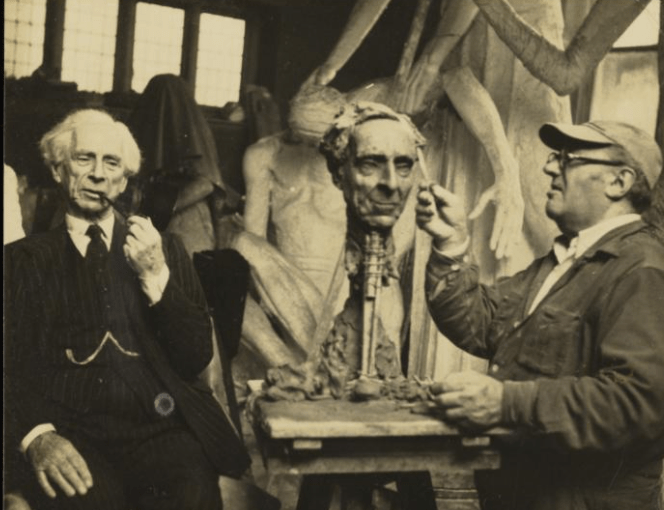
https://www.nobelprize.org/prizes/literature/1950/russell/biographical/
Bertrand Arthur William Russell (1872–1970) was a British philosopher, logician, essayist and social critic best known for his work in mathematical logic and analytic philosophy.
https://plato.stanford.edu/entries/russell/
Russell’s epistemology was an attempt to understand how modern science could be justified by appeal to sensory experience.
Russell’s definition of knowledge by description builds naturally on this: To know some thing or object by a definite description is to know that it is the so-and-so or that the so-and-so exists, i.e., that there is exactly one object that is so-and-so (Russell 1912: 82–3).19 Jan 2004
https://plato.stanford.edu/entries/knowledge-acquaindescrip/
Jean-Paul Sartre,
“My thought is me: that’s why I can’t stop. I exist because I think… and I can’t stop myself from thinking. At this very moment – it’s frightful – if I exist, it is because I am horrified at existing. I am the one who pulls myself from the nothingness to which I aspire.”
― Jean-Paul Sartre, Nausea
What does Sartre mean by the other?
Sartre also describes a third structure of being, being-for-others, which is one’s being as it exists in the consciousness of another.
Sartre believe that human existence is the result of chance or accident.
Part of the explanation, in my view, lies in the fact that knowledge for Sartre is what we may call a contrastive notion: knowledge is what consciousness – including one’s primary relation to oneself, to one’s own body, to other beings in a situation, and to the world – is not.
Knowledge (Chapter 12) – Jean-Paul Sartre
Sartre argues, if one insists that all consciousness is intentional in nature, one must conclude that even so-called “images” are not objects “in the mind” but are ways of relating to items “in the world” in a properly imaginative manner, namely, by what he calls “derealizing” them or rendering them “present-absent.”
The artwork, for Sartre, has always carried a special power: that of communicating among freedoms without alienation or objectification.
https://plato.stanford.edu/entries/sartre/#Ont
Immanuel Kant (1724–1804) is the central figure in modern philosophy. He synthesized early modern rationalism and empiricism, set the terms for much of nineteenth and twentieth century philosophy, and continues to exercise a significant influence today in metaphysics, epistemology, ethics, political philosophy, aesthetics, and other fields. The fundamental idea of Kant’s “critical philosophy” – especially in his three Critiques: the Critique of Pure Reason (1781, 1787), the Critique of Practical Reason (1788), and the Critique of the Power of Judgment (1790) – is human autonomy. He argues that the human understanding is the source of the general laws of nature that structure all our experience; and that human reason gives itself the moral law, which is our basis for belief in God, freedom, and immortality. Therefore, scientific knowledge, morality, and religious belief are mutually consistent and secure because they all rest on the same foundation of human autonomy, which is also the final end of nature according to the teleological worldview of reflecting judgment that Kant introduces to unify the theoretical and practical parts of his philosophical system.
https://plato.stanford.edu/entries/kant/
What is Kant’s epistemology?– is an epistemological one, as is his most famous doctrine, that we cannot cognize ‘things in themselves’ [Dinge an sich selbst]. … Consequently, Kant and Kantian ideas have figured prominently in discussion in epistemology, in particular about a priori knowledge.
Kant: Epistemology – PhilPapers
The 3 Big Questions of Philosophy
- What is knowledge? This refers to the following kinds of issues and questions: How can we know anything (i.e., the starting position of the radical skeptic)? …
- How should we conduct ourselves? …
- How should we govern ourselves?

 Sarah Chalkie Cloonan