Can a gallery be both a space of art production and a space of display?
In my essay I shall be focusing on the Whitechapel Gallery as the place of display, asking if it might be a place of production too. I shall be experimenting with ethnographic and phenomenological research methods at the gallery and making a collage to evidence my findings.
I am interested to see if the visitor might be Jacques Rancière’s (1992) ‘unpredictable subject’ and if the making space created in parallel to the gallery’s current exhibition, A Century of the Artist’s Studio: 1920 – 2020 (Whitechapel Gallery, 2022) is merely an inspirational escape. I suspect if the audience does engage with The Living Studio, the making space, it will change their experience, creating subjectivity, conscious critical thought and in turn knowledge. The real question for me will be: without an instructor, guidance, or rules, can this gallery-making space engage with the visiting audience from the A Century of the Artist’s Studio exhibition?
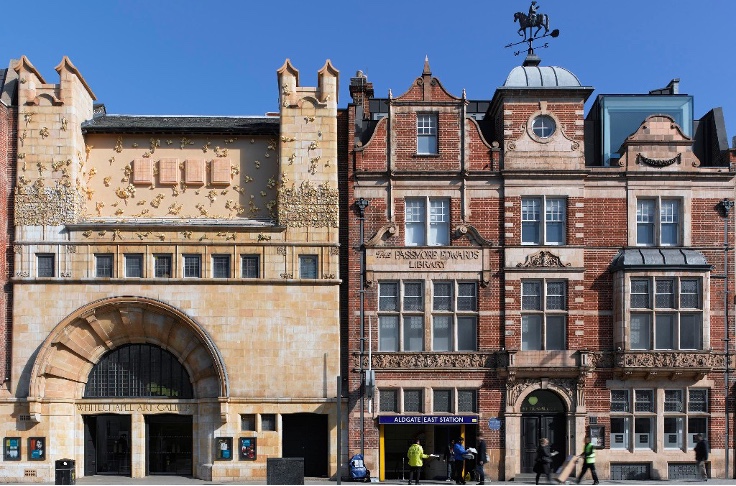
This is the facade of the Whitechapel Gallery today in 2022. It shows the 2012 addition of Rachel Whiteread’s ‘The Tree of Life’ – an Arts and Crafts motif symbolizing social renewal through the arts (Whitechapel, 2022).
On the Whitechapel Gallery’s website, they state the following:
‘The historic mission of Whitechapel Gallery is to serve the people of London by giving a platform to world-class art.’ (Dr David Dibosa, Chair of Trustees, Whitechapel Gallery, 2022 p.3).
This statement outlines the Whitechapel Gallery’s current approach to their curatorial practice vision for their social and political work. The ethos of care and provision has always been a fundamental part of the Whitechapel Gallery’s manifesto. However, it does not mention art production, although it does cite that it aims to display art.
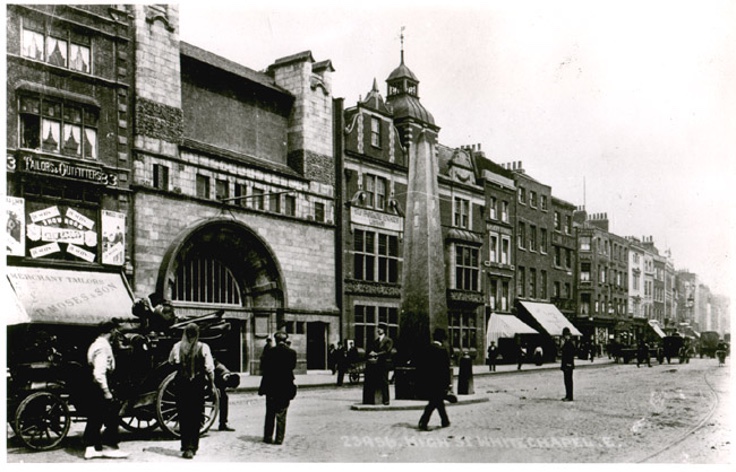
The Whitechapel Gallery’s Arts and crafts facade in 1905 designed by Charles Harrison Townsend in 1901 (Whitechapel Gallery, 2020).
Originally, when the gallery was founded by Canon Samuel and Henrietta Barnett in 1901, the gallery’s ethos was:
‘…to open to the people of East London a larger world than that in which they usually work. To draw them to a pleasure recreating their minds, and to stir in them a human curiosity’ (Whitechapel Gallery Trustees, 1901).
Originally, when the gallery was founded by Canon Samuel and Henrietta Barnett in 1901, the gallery’s ethos was:
‘…to open to the people of East London a larger world than that in which they usually work. To draw them to a pleasure recreating their minds, and to stir in them a human curiosity’ (Whitechapel Gallery Trustees, 1901).
Follow the link below for the full essay.

 Sarah Chalkie Cloonan